Made my first stock purchase in a while last week. I'm pleased to say that like 99% of Canadian investors, I'm now a happy owner of bank stocks. I put $3200 into BMO shares. Yes, yes, I know that BMO's currently trading at an all-time high -- but we're talking about the big banks here, people: the old rules don't apply. I'm not expecting my shares to skyrocket overnight so I can cash out in a few weeks time, but in terms of buy-and-hold Canadian dividend investing, the banks really are no-brainers. I'm confident my tiny stake in BMO will do what I hope it will -- slowly grow over time, giving me dependable capital gains and a steadily increasing dividend payout.
That'll probably be the last position I'll be instigating in Canada for a while now, because barring a major market correction, the whole TSX looks a tad pricey to me. As per my asset allocation targets, my next purchase will probably be to pad up my international holdings -- most likely via an emerging market ETF since I currently have no exposure to that sector.
Monday, April 23, 2007
Trading note -- Bring on more bank fees, I say

Thursday, March 01, 2007
I'm a bad little asset allocator...
Asset allocation -- it's the cornerstone of any long-term investing plan and it's a topic I find myself thinking about a lot of late, mainly because I think I'm cheating on the fixed income portion.
For newbies, asset allocation refers to the ratio in which you keep the funds you have in different investment vehicles. At it's most basic level, asset allocation means deciding how much of your total nest egg you earmark for safe fixed-income instruments like bonds, GICs and high-interest savings accounts, and how much you put into stock market equity, which generally holds the potential for higher returns, but also a higher risk of losing capital. Other asset allocation models are even more complex, including things like real estate, precious metals, etc. into the total financial outlook, but generally speaking most asset allocators stick to a fairly striaghtforward strategy like the one above. The idea is to diversify so that all your investments don't move up and down in lockstep -- as one investment moves up in value, you sell off a little and buy into the classes that haven't done as well to hedge your bets over the long term.
An oft-quoted rule of thumb for asset allocation is that the percentage you devote to fixed income should be equal to your age -- the idea being that the older you are, the more conservative you want to be, so the less risky, more capital-preserving investments you're going to want to gravitate towards. That framework always sat right with me.
If that's the case, I should be directing 26% of my net worth (currently at $29,443 according to my NetworthIQ report for this month) towards fixed income products. In my case, the vehicle I've chosen is a high-interest savings account with ING. So my fixed-income holdings should be at around $7,655 if I were a good little asset allocator. As it stands, I'm way above that level, with more than $11,000 sitting around in cash, gaining interest every month. I generally like to roll the dice a little bit and devote more funds towards equities while I'm young, so I was surprised to find myself devoting nearly 40% of my net worth, effectively, to cash, but then I realized that number is skewed a little for three main reasons.
No. 1 -- I plan on buying real estate at some point in the next 18 months. So I'm filling that high-interest savings account with as much money as I can under the pretense that I can't afford to lose this as I need those funds to be around for a downpayment fairly soon. Secondly, while my ING account is my de facto house fund right now, it was originally started as my emergency fund where I stashed enough cash to cover my expenses for three to six months should the need arise. It’s since ballooned well beyond that, as I said, now doubling as a downpayment fund. But I still want to keep those few thousand dollars worth of "just in case" money in there, not really as an investment per se -- more like peace of mind.
The third reason I find that section of my portfolio larger than it should be is that I can't shake the nagging feeling I have that the stock market, particularly the TSX, is a tad overvalued. Things have been too good for too long, so my natural inclination is to keep a lot of cash on hand both to minimize my losses and also be able to buy back in after a correction -- something recent events seem to suggest might be happening as we speak.
This is the area where I think I'm "cheating" at my asset allocation. Technically, your asset allocation is supposed to change as your circumtances change, so I guess I'm just responding to the stimuli of my own situation the way you're supposed to. But at its core, the whole reason asset allocation works is because it forces discipline on to an investing plan. It's meant to veer you away from making decisions like piling more money into the latest hot sector or emerging market -- or the flipside, where you panic and sell off all your holdings in a particular class because of a bad quarterly statement. Indeed, you're supposed to shave off some of your winners and pad up your losers to come up ahead in the long run.
At any rate, I don't really see myself cutting back on my cash allocation, as all three factors I listed are strong actors on my decision-making process at the moment. But it still doesn't sit right that here I am, making excuses why it's OK for me to veer from the long term asset allocation plan "just this once." I'm consoled by the fact that if anything, I'm being overly cautious, as opposed to aggressive, by having a lot of money tied up in low-yielding investments. At the end of the day, nobody ever went broke by having too much money in their savings account.
Questions and comments welcome as always
Wednesday, November 29, 2006
Risk vs. Reward -- a rethink
Please forgive the following brief mathematical interlude. It's been a long time since I came across the phrase "standard deviation" in everyday life.
Conventional wisdom has it that the more tolerance for risk that an investor has, the higher they can expect their investment returns will be over the long term. In practical terms, this means investors who gravitate towards things like bonds and GIC's trade off higher potential returns in exchange for safety, security, and -- let's face it -- peace of mind. Conversely, risker investors expert better returns for their efforts.
There's nothing particularily revolutionary about that concept, but it's important to remember that the relationship between risk and reward does not necessarily go in a straight line.
Generally speaking, adding acceptable amounts of risk -- investing in emerging markets or volatile small cap stocks, for example -- to a balanced portfolio does allow for the possibility of superior investment returns over the long term. But in real terms, it's not a linear relationship: more risk does not necessarily mean exponentially more reward.
If you could put a numerical value on the level of risk you're taking, then doubling it doesn't necessarily mean you can expect to double the reward, depending on how much your initial risk. This graphic sums up what I'm clumsily trying to say quite well.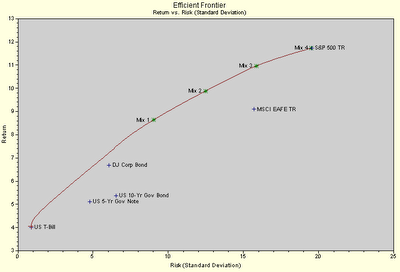
My apologies for usurping the original intentions of the chart-maker but essentially, stock data from the last 80-odd years seems to suggest something I've always believed to be true myself: The relative gains to be had from increasing one's risk exposure tend to decrease the more risk you're taking on.
See how the curve flattens out the further to the right on the "risk" axis you get? In practical terms, that means the bump you'd take from moving money from a GIC, for example, into a diversified blue-chip equity fund is a lot more, in relative terms, than the one you get from moving from one volatile sector into an even risker one.
The lesson? As always, diversify.
And don't take on more risk than is worth your while.


